


Krönt vägval – The chargeable transport distance used for price calculations in the forest industry
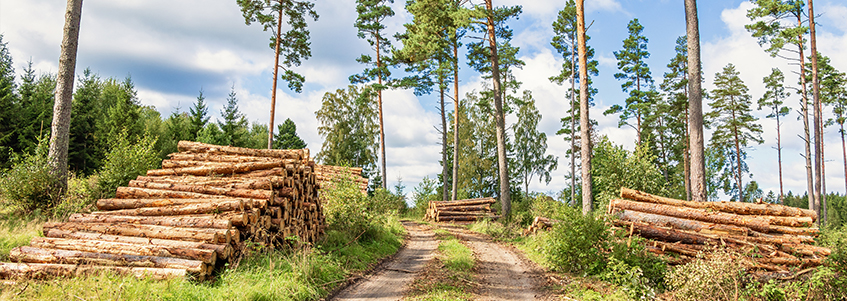
Every year in Sweden around 2 million loads of forest raw materials are transported, the majority of these being roundwood transports, from a pickup point in the forest to the processing plant.
Biometria’s Krönt vägval service is used to calculate the chargeable transport distance used for price calculations between the pickup point in the forest and the processing plant. This is used by buyers and haulers as the basis for payment.
Problem/Challenge
When trucks started to replace log floating it was a challenge to determine an accepted distance the haulers wanted to be reimbursed for.
Different methods have been used through the years, with varying degrees of success. When the NVDB emerged in the early 2000s the idea was born to develop a service where a distance was calculated, this distance would be accepted by both buyers and transporters.
The Solution
The service – which was named Krönt vägval – calculates a chargeable distance, from the pickup point in the forest to the processing plant. It was the former SDC - Skogsbrukets Data Central – that together with Skogforsk and Triona developed Krönt vägval. The first version was launched in 2009.
In addition to the distance, the route (actual stretch) and the energy value that the hauler generates are calculated. The energy value - which can be recalculated to a CO2 equivalent – can be used by buyers and haulers in their sustainability reports.
Krönt vägval is built on Triona’s TNE platform, where TNE (Transport Network Engine) is used for storing NVDB data and TRE (Transport Routing Engine) is used for calculating the routes. TNE is updated every night with NVDB data from the Swedish Transport Administration (Trafikverket). In addition to the NVDB data, Biometria adds some of its own road network information, which affects how the route is calculated. This could be information that determines how the transports are to be carried to and from the processing plants. This is to avoid transports being routed through undesired areas.
Skogforsk has produced the algorithms for Krönt vägval which based on the NVDB data and Biometria’s own information about the road network calculates the routes, based on the prerequisites which apply to forest transports.
Biometria and the Swedish forest agency (Skogsstyrelsen) also use Triona’s TNE Editor for updating various NVDB data for the forest road network. This is to increase the quality of the calculated routes in Krönt vägval.
Result
Krönt vägval is one of Biometria’s most important services and needs to work without interruption. Each day roughly 100,000 distances are calculated, the majority of which are retrieved via an API. It is also possible to analyze and retrieve the data from a map service which is shown in the image below.
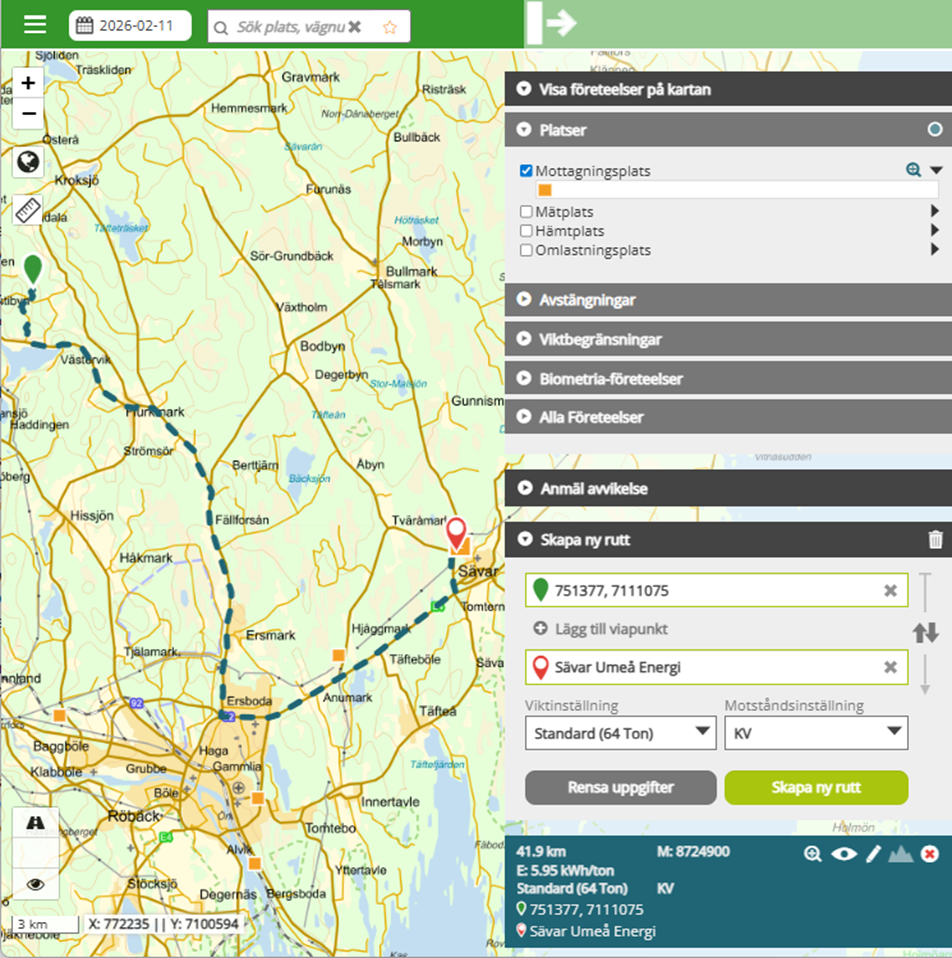
The image shows a calculated route – green dashed line – for a standard vehicle from a pickup point in the forest to a processing plant in Sävar, north of Umeå. The distance is 41.9 km, and the energy value is 5.95 kWh/tonne.
”Triona has – with their competence and the TNE product and the accompanying TRE module – for over 20 years been an important and reliable partner for Biometria in the development of the Krönt vägval service.” Lars-Erik Jönsson, Transport manager, Biometria
Customer: Biometria
Industry: Forest Industry, Transport, Infrastructure
Problem: To determine an industry-agreed chargeable transport distance for roundwood transports.
Solution: Using Triona’s TNE product and TRE module, data from the National Road Database (NVDB), Biometria, and algorithms from The Forestry Research Institute of Sweden (Skogforsk) a service was developed which calculates distances for routes based on the prerequisites for forest road transport.
Keywords:#TNE, #TRE, #TNEEditor, #Biometria, #KröntVägval, #NVDB, #Trafikverket, #Skogforsk, #GIS
